The Bay and Its Seasons
Reading a Surface on Foot Before a Boat Works It
Walking a flat before running it shows what traffic and water have built: brake marks, drainage, soft edges, and the lines that form under repeated use.
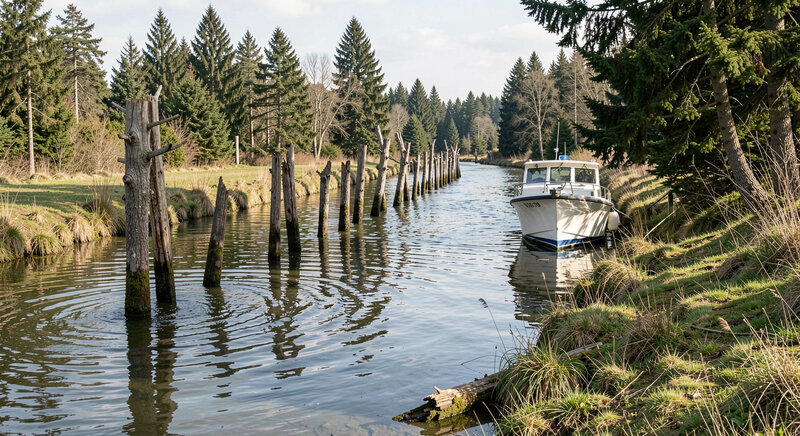
Walking a surface on foot shows what a boat under power cannot: the surface itself. A hull at speed reads water through pressure and spray, while a person on foot reads texture, moisture, slope and the marks left by earlier traffic. On a flat, that difference decides whether a line holds or folds, and it is the same discipline a rider uses when reading trackcraft before a moto.
What does walking a surface on foot show that riding it does not?
A boat moving across a flat compresses the reading into seconds. The operator feels the hull lift or drag, hears the wash, watches the bow. What is missing is the ground truth: how wet the surface is at the edge, where the grain has been polished by repeated passes, where a soft pocket sits just under the surface, and where drainage has cut a channel that will pull a running line sideways.
On foot, the same flat becomes legible. Boots sink or hold. A hand dragged across the surface shows whether the top layer is loose or packed. The eye catches the difference between a mark made this morning and a mark made last week. That is the same order of information a rider gathers by walking a private motocross track before riding it, as set out in the practical guidance at reading trackcraft on foot: surface condition, braking marks, flagging and exit lines are read before the machine is asked to commit.
For a boat working a flat, the walk answers three questions. Where does the surface hold? Where does it give? And where has water already chosen the line?
How does water shape a surface under repeated traffic?
Water does the shaping, traffic does the repeating. A flat is not static. Rain, tide, seepage and wash from passing hulls move fine material across it. Under repeated traffic, that movement concentrates. The result is a surface with a memory.
The first pass displaces a little material. The second pass follows the same low spot because it is already lower. By the tenth pass, a groove exists. By the hundredth, it is a channel with a defined edge, and the edge is where the surface is firmest. This is the same mechanism that builds ruts and berms on a dirt track: water finds the low line, traffic widens it, and the raised shoulder becomes the load-bearing part of the turn.
On a flat, the visible signs are consistent. A darker band usually means moisture retained, which can mean softer ground. A lighter band with a hard rim usually means material has been pushed aside and the base is exposed. Scattered shell, gravel or weed at the margin marks where wash has deposited heavier material. A channel running across the intended line is a drainage path, and it will keep pulling water and traffic into itself.
The practical consequence is that the line a boat wants is often not the line the surface offers. The firmest ground may sit on the shoulder of a worn channel rather than in its center. Reading that before launching avoids the slow discovery that comes from feeling the hull drag halfway across.
What maintenance belongs between two runs and after rain?
Between two runs, the work is small and specific. Clear the obvious debris that has moved into the working area. Note any new soft spot and mark it mentally or physically. Check the edge where the surface meets deeper water, because that is where erosion starts. If a channel has widened since the last run, that is the item to watch on the next pass.
After rain, the order changes. Water is still moving, so the first task is to observe rather than to use. Walk the flat and note where water stands, where it runs, and where it has already cut. Standing water on a flat usually indicates a low spot with no outlet, and that spot will stay soft long after the rest has firmed. Running water indicates a drainage path, and a drainage path under traffic becomes a channel.
Maintenance after rain is mostly about not fighting the water. Redirecting flow with a shallow cut or a placed barrier can protect a working line, but the cut itself must be maintained or it will silt and fail. On a private track, the equivalent routine is the between-moto check: clear the line, inspect the berms, water if the surface is drying too fast, and drain if it is holding too much. The same logic applies to a flat, with tide and seepage replacing the watering schedule.
Why read the surface before the boat works it?
Because the surface is the constraint. A boat can only work the flat that exists, not the flat that was imagined from the chart or from last season. Reading on foot converts a general area into a set of specific lines, each with a known firmness, a known edge and a known drainage behavior.
That reading also protects the surface. A hull that runs the wrong line on soft ground does damage that lasts: it deepens a channel, displaces material and changes where water will go next time. Walking first is not caution for its own sake. It is the cheapest way to keep a flat usable across a season.
The same principle holds wherever a surface is worked under load. The person who walks it before using it sees the marks, the moisture and the drainage, and then chooses a line that the ground can actually carry.
What marks on the surface matter most?
Not every mark is equal. The ones that matter are the ones that predict behavior under load.
A polished band, where the surface has been smoothed by repeated contact, usually indicates firm, consistent ground. A ragged edge beside it indicates where material is being lost. A crack running across the line indicates drying and shrinkage, which can mean the surface is firmer than it looks but also more brittle. A damp patch with no visible outlet indicates a low spot that will soften under traffic.
Braking marks and turn marks, the same features a rider reads on a track, translate directly. A mark that fans out shows where a line was entered too fast or too wide. A mark that cuts in sharply shows where the surface allowed a tighter turn. On a flat, the equivalent is the wash pattern left by earlier hulls: a wide, even wash suggests a stable line, while a narrow, deep cut suggests a line that is being forced.
Reading these marks takes minutes. Ignoring them costs a season of surface repair.
How should a walk change the plan for the day?
The walk should change the order of work, not just the choice of line. If the surface is holding water, the first runs should stay on the firm shoulders and avoid the soft centers. If a channel has widened, the working area should shift until it is repaired or until the water drops. If the edge is eroding, the day's plan should include a repair before the next tide or the next rain.
A walk also sets expectations for the boat. A flat that reads firm on foot will usually carry a hull cleanly. A flat that reads soft will demand lighter loading, shorter runs or a different line entirely. The reading is not a formality. It is the first decision of the day, and every later decision depends on it.